Real Stores, Real Shoppers
We observe in actual retail environments — hypermarkets, drugstores, pharmacies, specialty shops. No lab simulations, no artificial settings.
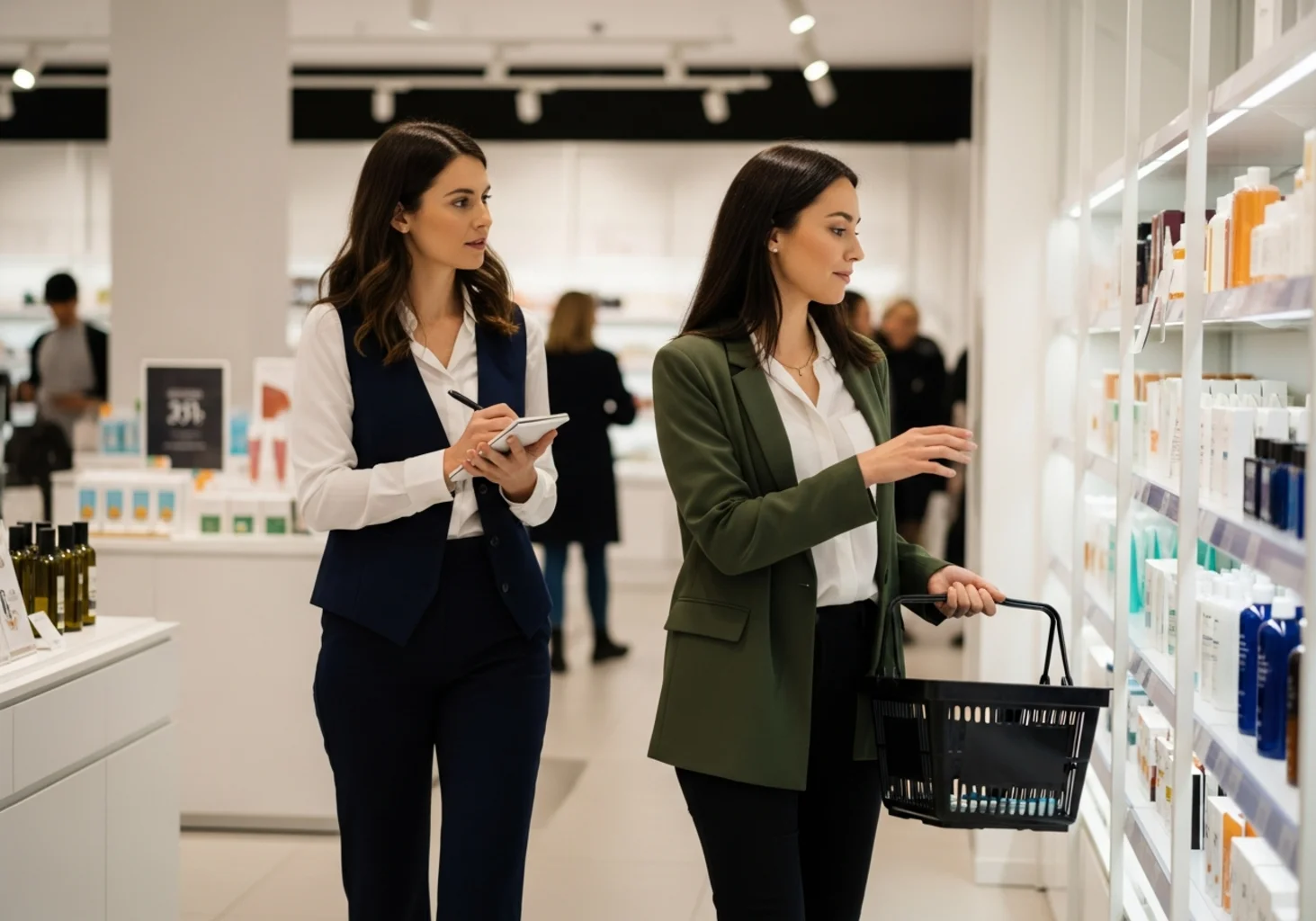
Walk the aisle with your consumer. See what they really do at the shelf.
Shop along — also known as accompanied shopping — is an observational qualitative method in which a researcher accompanies a consumer through a real shopping trip, documenting every decision, hesitation, and interaction at the shelf in real time. Unlike surveys, which capture rationalised post-hoc accounts, shop along records actual behaviour at the point of sale: which products catch the eye, what triggers a pick-up, which labels are read, and what ultimately lands in the basket. Fieldstat conducts shop along studies across all major Polish retail formats — hypermarkets, supermarkets, discounters, drugstores, pharmacies, and specialty stores — giving brands an unfiltered view of how shoppers truly behave.
How it works. A Fieldstat researcher meets the respondent at the store entrance. From that moment, every action is observed and documented: which sections the shopper visits first, how they navigate the aisle, which products catch their eye, what triggers a pick-up (colour? shape? promotion sticker? brand familiarity?), which products are picked up and put back, whether labels are read (and which information is checked — price, ingredients, origin, brand), and what ultimately lands in the basket. Throughout, the researcher asks non-directive questions: “What made you pick that up?” “Did you consider another option?” “What would make you switch?”
Declaration vs. reality — the shelf-level gap. This is pure ethnographic method applied to retail. Unlike surveys (where respondents construct idealised shopping narratives after the fact) and lab-based shelf tests (which lack the chaos, time pressure, and social context of real shopping), shop along captures behaviour as it happens. The insights are visceral: you learn that your “premium” packaging blends into the shelf because it’s the same navy blue as three competitors; that your 2-for-1 promotion is invisible because the sticker is at ankle level; that shoppers in this format don’t walk past aisle 4 at all.
Where we conduct shop along. Hypermarkets (Auchan, Carrefour), supermarkets (Biedronka, Lidl, Stokiłowicz), discounters, drugstores (Rossmann, Hebe), pharmacies, electronics stores, DIY retailers, and specialty food shops. We match the retail format to your distribution strategy. A typical project involves 10–25 accompanied shopping sessions across 2–4 retail formats.
Combining shop along with other methods. For the most complete shopper intelligence, we pair shop along with eye tracking glasses (what exactly the eye sees on the shelf), post-trip IDI (deeper exploration of motivations), and quantitative CAWI (scaling shop-along findings to a representative sample). This multi-method approach gives you the full picture: what shoppers see, what they do, why they do it, and how widespread the behaviour is.
Sources: POPAI, Nielsen Shopper, Fieldstat project data
| Method | What It Captures | Environment | Limitation |
|---|---|---|---|
Shop along |
Real behaviour + real-time reasoning |
Actual store |
Observer effect (fades quickly) |
Survey / CAWI |
Declared behaviour (post-hoc) |
Online |
Memory bias, idealisation |
Lab shelf test |
Controlled shelf interaction |
Studio |
Artificial context, no real purchase |
Eye tracking glasses |
Visual attention at shelf |
Actual store |
What they see, not why |
Receipt analysis |
Actual purchases |
Data only |
No context, no decision process |
We observe in actual retail environments — hypermarkets, drugstores, pharmacies, specialty shops. No lab simulations, no artificial settings.
We capture the moment of truth: what triggers a pick-up, what causes rejection, what role price/promotion/packaging plays in the final decision.
We compare shopper behaviour across retail formats (hypermarket vs. discounter vs. drugstore) to inform your channel strategy.
Every session is documented with photos, researcher notes, and optional video. Rich material for category management and trade marketing presentations.
We define the product categories, retail formats, and shopper profiles to study. We align on observation priorities and key research questions.
We recruit 10–25 shoppers matching your target profile — category users, specific retail format shoppers, demographic and behavioural criteria.
Our researchers accompany each shopper through a real shopping trip, observing behaviour, asking non-directive questions, and documenting everything with photos.
After shopping, we conduct a 15–20 minute follow-up interview to explore reasoning behind key decisions and capture reflections.
You receive a visual report with shopper journey maps, decision trees, shelf interaction analysis, and actionable recommendations for packaging, display, and channel strategy.
We recommend 10–25 sessions for robust pattern identification. For multi-format or multi-category studies, this may increase to 20–30 sessions.
Individual sessions cost PLN 800–1,500 each. Full projects (15 sessions + report) typically range PLN 15,000–30,000.
Minimally. After 5–10 minutes, shoppers revert to habitual behaviour — shopping is a deeply ingrained routine that is very difficult to consciously alter. Our researchers are trained to be unobtrusive.
Hypermarkets (Auchan, Carrefour), supermarkets (Biedronka, Lidl), discounters, drugstores (Rossmann, Hebe), pharmacies, electronics stores, DIY retailers, and specialty shops.
Yes — this is our premium shopper research package. Respondents wear eye tracking glasses during shopping, recording exactly what they see at the shelf. Combined with researcher observation and post-trip interview, this provides the most complete shopper intelligence available.
The shopping route (which sections, in what order), shelf interaction (scanning pattern, product pick-ups, label reading), decision triggers (price, promotion, packaging, brand), comparison behaviour, staff interaction, and final basket contents.
Observational Research Methods (Wikipedia)
https://en.wikipedia.org/wiki/Observational_methods_in_psychologyPOPAI — Point of Purchase Research
https://www.popai.com/ESOMAR — Observational Research Guidelines
https://esomar.org/code-and-guidelines/icc-esomar-code